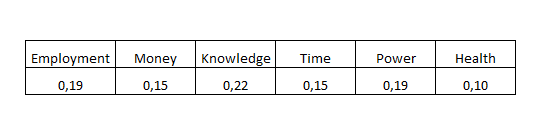
Methodological note. GEI: Basic methodology
The Gender Equality Index is a composite indicator that is obtained by adding the equality values calculated for a series of basic indicators – each of which reflects a different aspect of the well-being and personal development of men and women – into a single measure which captures the multidimensionality of the phenomenon of gender equality and expresses it on a dimensionless scale, in which 1 means total inequality and 100 total equality.
The Gender Equality Index is calculated using the methodology of the European Institute for Gender Equality (EIGE) in its 2017 version. Unlike other methodologies, which adopt the approach of female empowerment, this methodology aims to measure the degree of equality existing, regardless of whether the observed gap favours one sex or the other.
The 2017 version of the methodology, which is applied in the 2018 edition of the Gender Equality Index for the Basque Country, comprises 31 indicators structured hierarchically into six domains (Employment, Money, Knowledge, Time, Power and Health) that are in turn divided into fourteen sub-domains. The list of indicators used, adapted to the geopolitical reality of the Basque Country and the availability of information is as follows:
Employment Domain
- Full-time employment: Equivalent rate of full-time employment (percentage of the employed population aged 16 and above). Starting with the 2024 edition, the population reference becomes the employed population between 15 and 89 years old.
- Working life duration: Working life duration (in years).
- Segregation by activity sectors: Employment in Education, Healthcare and Social Services (percentage of the employed population aged 16 and over).
- Working flexibility for personal and family reasons: Proportion of the salaried and integrated population that feels it can balance working life with social and family obligations.
- Career prospects: The Career Prospects Index is one of job quality indexes developed by Eurofound on the basis of four indicators that measure the employment situation, the prospects for career advancement as perceived by the worker, perceived likelihood of losing one’s job and experience of downsizing in the organisation. It is measured on a scale of 0-100 where the higher the score, the higher the job quality. As it is impossible to calculate it for the Basque Country, data from Spain is used.
Money Domain
- Wages: Average net pay made by the salaried and integrated population (units of purchasing power for the last month paid).
- Income: Average equivalent household income per capita of the population aged 16 and above (units of purchasing power).
- Risk of poverty: Individuals not at risk of poverty, i.e. whose equivalent household income per capital is equal to or greater than 60% of the average income (percentage of the population aged 16 and above).
- Distribution of income: Ratio between income quintiles 20 and 80 (percentage of the population aged 16 and above).
Knowledge Domain
- Higher education: Individuals who have a tertiary/higher education qualification (percentage of the population aged 15 and over). Starting with the 2024 edition, the population reference becomes the employed population between 15 and 89 years old.
- Ongoing education: Individuals in regulated/non-regulated education during the last four weeks (percentage of the population aged 15 and over). Starting with the 2024 edition, the population reference becomes the employed population between 15 and 89 years old.
- Segregation by field of study: University students in the fields of Education, Health & Well-Being and Arts & Humanities (percentage of university students).
Time Domain
- Caring for people: Individuals who habitually dedicate some time to caring for children and/or the elderly or dependants (percentage of the employed population aged 18 and above).Starting with the 2024 edition, the population reference becomes the employed population between 15 and 89 years old.
- Domestic activities: Individuals who habitually dedicate some time to carrying out domestic activities (percentage of the employed population aged 18 and above). Starting with the 2024 edition, the population reference becomes the employed population between 15 and 89 years old.
- Sports, cultural and leisure activities: Employed individuals who habitually undertake sports, cultural and leisure activities (percentage of the employed population aged 16 and above). Starting with the 2024 edition, the population reference becomes the employed population between 15 and 89 years old.
- Voluntary and charity activities: Employed individuals who participate in voluntary and charitable associations (percentage of the employed population aged 16 and above). Starting with the 2024 edition, the population reference becomes the employed population between 15 and 89 years old.
Power Domain
- Representation in the Government: Gender distribution of Government members.
- Parliamentary Representation: Gender distribution of members of Parliament.
- Representation in Provincial Assemblies: Gender distribution of provincial assembly members.
- Business Management: Gender distribution of individuals who are part of a Board of Directors in large companies.
- Public/Semi-Public Bank Management: Gender distribution of individuals who are part of a Board of Directors in public or semi-public banks
- Public R+D funding: Gender distribution of members of the principal collegiate bodies making decisions on public R+D funding.
- Public media: Gender distribution of members of the principal decision-making collegiate bodies of public media.
- Sports federations: Gender distribution of members of the principal decision-making collegiate bodies of the organisations for the most popular sports.
Health Domain
- Perception of own health: Perception of own health as good or very good (percentage of the population aged 16 and above).
- Life expectancy: Life expectancy at birth (years).
- Years in good health: Years in good health at birth.
- Consumption of tobacco and alcoholic drinks: Individuals who do not smoke or abuse alcohol (percentage of the population aged 16 and over).
- Healthy lifestyle habits: Individuals who undertake physical activity and/or consume fruit and vegetables (percentage of the population aged 16 and over).
- Healthcare: Individuals without health insurance not requiring healthcare (percentage of the population aged 16 and over).
- Dental care: Individuals without health insurance not requiring dental care (percentage of the population aged 16 and over).
In the 2020 edition of the Gender Equality Index of the Basque Country, Eustat also obtains the Gender Equality Indexes of the three provinces that make up the Basque Country. In order to achieve this objective it was necessary to make some adjustments to the definition of the basic indicators or the calculation criteria. The adaptations have affected the indicators detailed below: In the remaining cases, the definition of the indicators and the calculation procedure in the Provinces is identical to that described for the Basque Country.
Power Domain
- Representation in Government: Gender distribution of members of the governing bodies of the Provincial Councils.
- Parliamentary Representation: Gender distribution of provincial assembly members.
- Representation in Provincial Assemblies: Gender distribution of municipal mayors and councillors.
- Business Management: Gender distribution of individuals who are part of a Board of Directors in large companies.
- Public/Semi-Public Bank Management: Gender distribution of individuals who are part of a Board of Directors in public or semi-public banks Due to the autonomous nature of the institutions involved and in view of the lack of an equivalent within the scope of the Provinces, the value calculated for the Basque Country is also attributed to its three Provinces.
- Public R+D funding: Gender distribution of members of the principal collegiate bodies making decisions on public R+D funding. Due to the autonomous nature of the institutions involved and in view of the lack of an equivalent within the scope of the Provinces, the value calculated for the Basque Country is also attributed to its three Provinces.
- Public media: Gender distribution of members of the principal decision-making collegiate bodies of public media. Due to the autonomous nature of the institutions involved and in view of the lack of an equivalent within the scope of the Provinces, the value calculated for the Basque Country is also attributed to its three Provinces.
Health Domain
- Years in good health: Years in good health at birth. In calculating this indicator by province, information from the Basque Country Health Survey is used, on the incidence of good health situations by age in the Basque Country. This information applies indistinctly to each of the three provinces. Consequently, the differences by province in this indicator are due exclusively to the use of specific mortality tables for each province.
System for determining gender equality by indicator
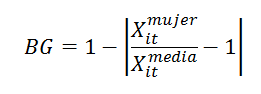
The Gender Gap (BG) is a measure of gender equality (not gender inequality). It is calculated from the ratio between the value for women and the average value for men and women in the basic indicator being analysed (X), which is converted into a scale where 0 signifies total inequality and 1 signifies total equality. This is done using the following formula:
The Measure of Gender Equality (M) (M) in each basic indicator (X) is calculated using the Gender Gap (GG), which is corrected via a Level Factor and converted into a scale that goes from 1 to 100, with 100 signifying perfect gender equality. The calculation is made thus:

The Level Factor is applied with the aim of taking into account the success rate for each country for a given indicator. Generally speaking, it is calculated as follows:
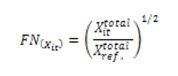
Where  is a benchmark value that the EIGE has established as the maximum value achieved by the variable X in any of the 28 countries of the European Union and in any of the following four tax years: 2005, 2010, 2012 and 2015. These values are published in the “Gender Equality Index. 2017. Measuring gender equality in the European Union 2005-2015” (page 108).
There are some exceptions to this formula:
- The total value of the indicator is not taken for the indicators of Life Expectancy, Years in Good Health and Income. Instead, the arithmetic mean is taken from the results obtained for men and women.
- No correction whatsoever is applied by means of Level Factor in the eight indicators in the Power domain and in two indicators (Caring for people and Domestic Activities) in the Time domain.
Aggregation in order to obtain the Gender Equality Inde
The Index structure takes into account four levels:
- The Gender Equality Index, maximum aggregation level.
- The Index of the six dimensions being studied: Employment, Money, Knowledge, Time, Power and Health.
- The Index for the subdimensions that each of the previous dimensions are divided into.
- The Index of the basic indicators, of which a measure of gender equality (M) is calculated for each.
The aggregation process that leads to the calculation of the Gender Equality Index occurs in the form of a scale that goes from level 4 to level 1 as follows:
The synthetic indices by subdimensions (S) are obtained by calculating the simple arithmetic mean for the measure of gender equality (M) for each basic indicator (X):
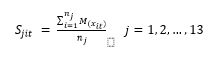
Where nj is the number of indicators included in each subdimension, and Sjit is the synthetic index for each subdimension, country and year.
The synthetic indices by dimensions (D) are obtained by calculating the geometric mean of the synthetic indices for the corresponding subdimensions (S):

Where nk is the number of subdimensions included in each dimension and Dkit is the synthetic index for each dimension, country and moment in time.
The Gender Equality Index (GEI) is obtained by calculating the weighted geometric mean of the indices for each dimension (D):
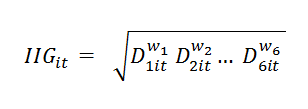
The weightings (w) utilised have been calculated by the European Institute for Gender Equality by applying the hierarchical clustering methodology: